

Blog

It would be convenient if there were one safe dose of Xanax. There isn’t. Someone with panic disorder might be doing fine on 3 mg a day, while that same 3 mg could leave a frail 80-year-old too unsteady to get to the bathroom safely at night. Add an opioid painkiller and the picture changes again.
What follows is how prescribers usually work out an alprazolam dose, using the FDA label as the starting point, and the things that make them go up or down. It should help you understand the numbers on your bottle. Changing those numbers, though, is a conversation to have with your prescriber first.
Why Your Dose Isn’t Anyone Else’s
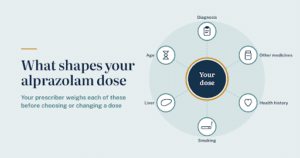
The rule the label gives prescribers is short: find the lowest dose that helps, and keep asking whether it’s still needed. Simple enough on paper. In practice, the lowest dose that helps depends on a handful of things about you.
What you’re being treated for is the big one. People with generalized anxiety usually need less alprazolam than people with panic disorder. The label handles the two conditions separately, with different starting doses and different limits.
Age matters too. Alprazolam stays in older bodies longer. The label puts the average half-life at roughly 16 hours in healthy older adults, compared with about 11 in younger ones. That means the same pill leaves more drug in the blood, for longer.
Then there’s your liver. It does most of the work of breaking alprazolam down, so when it isn’t working well, the drug builds up. In the label’s data, people with alcohol-related liver disease had an average half-life of nearly 20 hours.
Other medicines can nudge things either way. Certain antifungals and antibiotics block the enzyme that clears alprazolam, so levels rise. Carbamazepine speeds that enzyme up and pulls levels down. Opioids are a different story. They don’t change how much alprazolam is in your blood, but both drugs slow breathing, and together that effect adds up. That’s why prescribers start lower when someone takes both.
Two smaller factors catch people off guard. Alprazolam levels can run up to 50% lower in smokers. And people with obesity tend to clear it more slowly.
Last comes your history. If you’ve had problems with alcohol or drugs, have sleep apnea or another breathing condition, or have dealt with depression, a careful prescriber will go slower. That isn’t a judgment about you. Those are simply the situations where alprazolam is most likely to cause harm.
What Xanax Tablets Look Like
Brand-name Xanax comes in four immediate-release strengths, and each one has its own color. The 0.25 mg tablet is white, 0.5 mg is peach, and 1 mg is blue. The 2 mg tablet is white too, but longer, with several score lines across it.
Generic alprazolam is a different matter. It’s made by several companies, and their tablets don’t all look alike, so don’t rely on color to tell you the strength. Check the label on your bottle. If your refill suddenly looks different from last month’s, it’s almost always a new manufacturer. Ask the pharmacist anyway, just to be sure.
The extended-release version, Xanax XR, comes in 0.5 mg, 1 mg, 2 mg and 3 mg. Alprazolam is also sold as a tablet that melts on the tongue and as a liquid, both handy for people who struggle to swallow pills.
One warning belongs here. The DEA has repeatedly flagged counterfeit pills made to look like Xanax that actually contain fentanyl or other drugs. If a tablet didn’t come from a licensed pharmacy in a bottle with your name on it, there’s no telling what’s in it or how strong it is.
Starting Doses for Generalized Anxiety Disorder
For adults with generalized anxiety disorder, the label suggests starting at 0.25 mg to 0.5 mg, three times a day. From there, a prescriber can adjust the dose every three or four days depending on how it’s going. The ceiling is 4 mg a day, split into separate doses.
Plenty of people never get close to that ceiling. The label also asks prescribers to keep checking whether the medicine is still needed, and the patient Medication Guide points out that nobody knows for sure whether Xanax stays safe and effective for anxiety beyond four months.
That doesn’t mean treatment has to end at four months. It means longer use should be a decision your prescriber keeps revisiting with you, rather than a refill that runs on autopilot.
Starting Doses for Panic Disorder
Panic disorder starts a little higher: 0.5 mg, three times a day. If more is needed, the dose goes up every three to four days, by no more than 1 mg a day at each step.
The trials behind the approval used a wide range, anywhere from 1 mg to 10 mg a day. Most people landed around 5 or 6 mg, and a handful needed the full 10.
Higher doses bring more risk, and the label doesn’t soften that. Once someone is above 4 mg a day, it recommends regular check-ins and a serious look at whether the dose could come down. One study found that patients who’d been on more than 4 mg a day for three months could cut their dose in half without losing the benefit. Reports also suggest dependence is more likely, and tends to be worse, above 4 mg a day and after about 12 weeks.
Some people on a steady dose notice anxiety creeping back first thing in the morning, or an hour or two before the next dose is due. The label describes exactly this. If it sounds familiar, tell your prescriber. The fix might be spacing doses differently, switching to the extended-release form, or trying something else. An extra tablet you decide on yourself isn’t the fix.
How Xanax XR Is Dosed
Xanax XR is only approved for panic disorder. You take it once a day, ideally in the morning.
Most people start somewhere between 0.5 mg and 1 mg. Like the regular tablets, it goes up every three to four days, by no more than 1 mg a day at a time. In the trials, most people did well somewhere between 3 mg and 6 mg a day, and the occasional patient needed up to 10.
XR tablets have to be swallowed whole. Splitting, crushing or chewing one wrecks the slow-release design and can dump much of the dose into your system at once.
If you’re already on regular Xanax, your prescriber can usually switch you to XR at the same total amount per day, just taken in one go. Whether that makes sense for you is their call.
The Label’s Numbers in One Place
| Situation | Where the label starts | What it adds |
| Generalized anxiety disorder (regular tablets) | 0.25 mg to 0.5 mg, three times a day | Maximum 4 mg a day, split into doses |
| Panic disorder (regular tablets) | 0.5 mg, three times a day | Raise by no more than 1 mg a day, every 3 to 4 days |
| Panic disorder (XR) | 0.5 mg to 1 mg, once a day | Most people respond at 3 mg to 6 mg once a day |
| Older adults (regular tablets) | 0.25 mg, two or three times a day | Raise only if needed and tolerated |
| Older adults (XR) | 0.5 mg, once a day | Raise only if needed and tolerated |
| Liver impairment | Same as older adults | Raise only if needed and tolerated |
These are starting points, not a plan for any one person.
Why Older Adults and People With Liver Disease Start Lower
You saw the half-life numbers earlier. Here’s what they mean in daily life.
When alprazolam lingers, so do its effects. For an older adult, that often looks like drowsiness through the morning, fuzzy thinking, or legs that aren’t quite steady. Any of those can lead to a fall, and falls at this age can change everything. That’s why the label starts older adults at 0.25 mg two or three times a day (0.5 mg once a day for XR), and says to raise it only if it’s needed and tolerated. People with liver problems get the same careful start.
The American Geriatrics Society’s Beers Criteria lists benzodiazepines among medicines that are generally best avoided in older adults, while still allowing that some situations call for them. So a lower dose isn’t a rule that every older person should come off alprazolam. It’s a reason to weigh it carefully.
There’s one interaction worth singling out for this age group. Alprazolam has been reported to raise digoxin levels, especially in people over 65. If you or a parent takes digoxin for the heart, the label recommends checking digoxin levels before starting alprazolam and keeping an eye on them afterward.
When Another Medicine Changes the Dose
Some combinations just call for caution. A few change the dose outright, or rule alprazolam out entirely.
Opioids come first. The label says the combination should be reserved for people whose other options haven’t worked, and whichever drug gets added second should start low. Anyone on both should be watched for slowed breathing and heavy sleepiness, and the people they live with should know the warning signs too.
A small group of drugs block alprazolam’s main clearance pathway so strongly that alprazolam isn’t allowed with them at all. Ketoconazole, itraconazole and clarithromycin are on that list.
Ritonavir, an HIV medicine, is the odd one out. Its effect on alprazolam changes over time. When the two are started together, the label calls for cutting the alprazolam dose in half. After 10 to 14 days on both, the prescriber can bring it back up to the target.
Milder blockers, such as nefazodone, fluvoxamine, cimetidine and erythromycin, can still raise alprazolam levels enough that a lower dose may be needed. Even fluoxetine, a very common antidepressant, raised peak alprazolam levels by about 46% in one study. On the other side, carbamazepine and phenytoin can lower alprazolam levels so it doesn’t work as well.
Then there’s everything that makes you sleepy: alcohol, sleep aids, some allergy pills and certain psychiatric medicines. None of them change your alprazolam level, but they add to its effect.
The easiest protection is to let a pharmacist see your full list, over-the-counter products and supplements included, every time something new gets added.
The Maximum Is a Ceiling, Not a Goal
It’s easy to read “maximum 4 mg a day” as room to grow into. The label doesn’t mean it that way. As the dose climbs, so do drowsiness, memory problems and the risk of dependence, and coming off the medicine later tends to get harder.
The label also notes something most people don’t expect. The body adapts fairly quickly to some of alprazolam’s calming effect, but it barely adapts to the effects on memory and thinking. So if the relief you felt in week one has faded, raising the dose to get it back can leave you with more fog and forgetfulness and not much more calm. If that’s where you are, the thing to talk about with your prescriber is the plan itself, not one more milligram.
If You Miss a Dose
Go by the instructions that came with your prescription first. The general advice from MedlinePlus is to take the missed dose when you remember, unless your next one is almost due. In that case, skip the one you missed and carry on as normal. Don’t double up to make up for it.
If your prescription says to take alprazolam only as needed, missing a dose works differently. When you’re not sure, call the pharmacy before you take anything.
Signs Someone Has Taken Too Much
The label describes benzodiazepine overdose as a sliding scale. On the milder end, it can look like:
- heavy sleepiness
- confusion
- slurred speech
- clumsiness
- slow reflexes
- limp or floppy muscles
At the severe end, breathing slows and the person can slip into a coma. Mixed with alcohol, opioids or other sedating drugs, an overdose can be fatal.
Call 911 if someone is breathing slowly or shallowly, can’t be woken up, or isn’t responding. Don’t leave them to “sleep it off.” If the symptoms are mild and you just have questions, Poison Control is available at 1-800-222-1222 or at poisonhelp.org.
Lowering or Stopping Your Dose
Bringing a dose down is every bit as much a medical decision as raising it. The label calls for a gradual taper planned around the individual. If withdrawal symptoms show up along the way, the prescriber may pause, or step back to the previous dose for a while. Some people need a much slower pace than others.
Stopping all at once after regular use can trigger withdrawal, including seizures, and that can be life-threatening. The label also describes a drawn-out form of withdrawal in some people, with symptoms that hang on for weeks or even more than a year.
Wanting to take less, or to stop altogether, is a perfectly reasonable goal. Just plan it with your prescriber instead of going it alone.
Living With Alprazolam Day to Day
If your doses are scheduled, try to take them at about the same times each day. That keeps levels in your blood steadier.
If you use the liquid form, measure it with the dropper or syringe that comes with it. A kitchen spoon isn’t accurate enough for this.
Only split tablets if your prescriber or pharmacist has said it’s fine. XR tablets should never be split.
Keep the bottle somewhere locked, at room temperature, out of reach of kids and anyone visiting. Never give tablets to anyone else. With a controlled drug, that’s both unsafe and illegal. When you have leftovers you no longer need, most pharmacies can point you to a take-back program.
Frequently Asked Questions
What is the usual starting dose of Xanax?
Most adults being treated for generalized anxiety start on 0.25 mg or 0.5 mg, three times a day. With panic disorder, the first dose is usually 0.5 mg three times a day. If you’re older or have liver trouble, expect something smaller: 0.25 mg, two or three times a day.
What’s the most Xanax you can take in a day?
For generalized anxiety, the label stops at 4 mg a day, spread across the day. Panic disorder is less clear-cut. Some people in the original trials took as much as 10 mg a day. Once a dose goes past 4 mg, though, the label wants prescribers checking in regularly, because the risk of dependence climbs.
Is 1 mg of Xanax a lot?
For one person, maybe. For another, not at all. An adult with panic disorder might be prescribed that much or more, while someone who’s 80, or just starting out, might be told to take a quarter of it. Go by your own label, not anyone else’s.
Can I take an extra dose during a panic attack?
Not unless your prescriber has told you that’s okay. Doses taken close together overlap in your body, and that’s when heavy drowsiness and slowed breathing become a risk. If your attacks are breaking through, call your prescriber. That’s useful information for them.
Is it safe to take Xanax every day?
Plenty of people take it daily with a prescriber keeping an eye on things. The trade-off is that daily use makes physical dependence more likely, even when you take it exactly as written. Ask your prescriber every so often whether you still need it at the same dose.
What if my dose doesn’t seem to work anymore?
Tell your prescriber before you change anything. There are several possible reasons: your body may have gotten used to it, the timing may be off, or your anxiety itself may have changed. Each one has a different fix, and taking more on your own isn’t one of them.
The Bottom Line
Alprazolam dosing follows a fairly cautious pattern. Doctors start low, raise it in small steps, and look harder at anything above 4 mg a day. Older adults and people with liver disease get an even gentler start.
Where you fall in that pattern is between you and your prescriber. What you can control is taking it as written and keeping alcohol and other sedating drugs out of the mix.
Questions about your dose, when to take it, or how it fits with your other medicines? Visit our pharmacy or speak with our pharmacist.
References
- U.S. Food and Drug Administration. Xanax (alprazolam) tablets, prescribing information and Medication Guide (revised 1/2023). DailyMed / Drugs@FDA.
- U.S. Food and Drug Administration. Xanax XR (alprazolam) extended-release tablets, prescribing information. DailyMed / Drugs@FDA.
- MedlinePlus. Alprazolam.
- Drug Enforcement Administration. One Pill Can Kill (counterfeit pill warnings).
- American Geriatrics Society. 2023 Updated AGS Beers Criteria.