

Blog

This question usually comes up for a practical reason: How Long Does Xanax Stay in Your System? A new job wants a drug test by Friday. A surgeon’s office is asking about your medicines. You stopped Xanax last week and want to know if it’s really gone. Or you took a tablet at bedtime and still feel slow at lunch.
There isn’t one answer, because “in your system” can mean different things. You stop feeling Xanax long before it’s out of your blood, and a lab can pick up traces for a while after that.
How Your Body Gets Rid of Alprazolam
Your liver handles most of it. After a tablet is absorbed, an enzyme in the liver called CYP3A4 breaks alprazolam down into smaller pieces. One of those is alpha-hydroxyalprazolam, but there’s so little of it compared with the drug itself that it barely adds to the effect. Your kidneys then send what’s left out in your urine.
So if your liver is sluggish, or something is getting in the way of that enzyme, alprazolam leaves more slowly.
Half-Life, in Plain Terms
Half-life is the time it takes for the level in your blood to drop by half. For alprazolam in healthy adults, the FDA label gives an average of about 11.2 hours. That average hides a lot of variation. In the label’s data, some people cleared it in roughly 6 hours and others took about 27.
A common rule of thumb says a drug is mostly out of the blood after about five half-lives. Apply that rule to the label’s averages and you get rough clearing times for a single dose:
| Group (from label data) | Average half-life | About five half-lives |
| Healthy adults | about 11 hours | about 2 to 2.5 days |
| Healthy older adults | about 16 hours | about 3.5 days |
| People with alcohol-related liver disease | about 20 hours | about 4 days |
| People with obesity | about 22 hours | about 4.5 days |
Real people don’t always match the averages. The label’s individual results cover a much wider range, and a few people with liver disease had half-lives longer than 60 hours.
Daily use adds another wrinkle. If you take alprazolam every day, it builds up to a steady level in your body. When you stop, there’s more of it to clear, even though your body works through it at about the same rate.
Dose size matters less than you might think. A bigger dose means more drug to clear, but your body clears it at about the same rate.
The Feeling Fades Long Before the Drug Does
After a regular tablet, the calm usually wears off within several hours. The drug doesn’t leave that fast. Once the level in your brain drops below a certain point you stop noticing it, even though a lab could still measure plenty in your blood.
That leftover alprazolam still does things. It’s part of why some people wake up foggy after an evening dose. It can also add to the effects of alcohol, sleep aids or other sedating medicines you take later that day, or even the next day. And it’s what a drug test is picking up.
What Makes It Stick Around Longer
Age and liver health are the big ones. In the label’s data, older adults cleared alprazolam more slowly and ended up with higher blood levels than younger adults on the same dose. Liver disease can stretch the half-life much further, since the liver is doing most of the work.
Weight matters more than people expect. The average half-life in people with obesity was about twice that of healthy adults.
Other medicines can push it either way. Some antifungals and antibiotics, certain HIV drugs, fluvoxamine and cimetidine all block CYP3A4, so alprazolam lingers. Carbamazepine and phenytoin speed that enzyme up. Smoking pulls levels down too, by as much as half in the label’s numbers.
Then there’s plain exposure. Weeks of daily doses leave a lot more to clear than one tablet does.
How Long Xanax Shows Up on Drug Tests
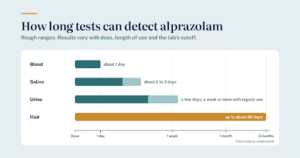
You won’t find detection windows on the drug label. They come from testing labs and medical studies, and the published numbers don’t always agree. Treat these ranges as a rough guide:
| Test type | Typical detection window for alprazolam |
| Blood | About 1 day |
| Saliva | About 2 to 3 days |
| Urine | A few days after occasional use; a week or longer after regular use |
| Hair | Up to about 90 days |
Where you land in those ranges depends on:
- your dose
- how long you’ve been taking it
- how quickly your body works
- which test and cutoff the lab uses
Which Tests Look for Benzodiazepines
Plenty of drug screens don’t check for benzodiazepines at all. The basic 5-panel test many workplaces use usually skips them. Bigger panels, like the 10-panel, usually include them. If you’re not sure what a test covers, it’s fine to ask.
Tests generally look for alprazolam itself and its breakdown products. The first-round screen, called an immunoassay, is quick but not very precise. Some benzodiazepines slip past it, and now and then it reacts to something that isn’t a benzodiazepine at all. So a positive screen usually gets sent for a second, more precise lab test, typically GC-MS or LC-MS, before anyone acts on it.
False Positives
A couple of everyday medicines have been linked to benzodiazepine screens coming back positive in people who never took one. Sertraline (Zoloft), a widely used antidepressant, is one. Oxaprozin, an anti-inflammatory painkiller, is another. The labeling for both drugs mentions it.
If you take either one, let the testing service know up front. And if a result comes back positive when you know it shouldn’t, ask for the confirmatory test.
If You Have a Prescription
Workplace results usually pass through a Medical Review Officer first. That’s a doctor whose job is to look into positive results before they reach your employer. If you have a valid alprazolam prescription, they can check it, and often they’ll report the result to your employer as negative.
Jobs with strict safety rules, like commercial driving or flying, can work differently. Either way, keep your prescription details handy and share them the way your testing program asks you to.
Don’t Try to Clear It Faster
People try all sorts of things: gallons of water, hard workouts, detox drinks from the gas station. None of it changes how fast your liver breaks alprazolam down.
Stopping suddenly is worse than useless. If you’ve been taking alprazolam regularly, quitting a few days before a test can set off withdrawal, and benzodiazepine withdrawal can include seizures. If you have a prescription, tell the testers about it and keep taking your medicine as prescribed.
After You Stop Taking Xanax
When someone who’s been taking alprazolam regularly stops, withdrawal can begin as levels drop. Alprazolam clears faster than longer-acting benzodiazepines like diazepam, so withdrawal can show up sooner.
The label lists a wide range of symptoms. Anxiety, trouble sleeping and headaches are common, and seizures can happen in severe cases. A smaller group of people have what the label calls protracted withdrawal, with symptoms that drag on for weeks or, in some cases, more than a year.
So if you’re ready to stop, plan it with your prescriber. The label calls for a gradual taper worked out for the individual.
Surgery, New Medicines and Other Situations
Going in for surgery or a procedure? Tell both the surgeon and the anesthesiologist that you take alprazolam, even if your last dose was a day or two ago. Anesthesia and pain medicines, opioids especially, add to its effects. They may also need to work your usual dose into the plan so you don’t slip into withdrawal while you’re in the hospital.
Any time you start something new, even a five-day antibiotic or a short course of antifungal pills, have the pharmacist check it against alprazolam first. Some of those short courses are exactly the ones that interact.
If you’re breastfeeding, know that alprazolam gets into breast milk. The label recommends not breastfeeding while you’re taking it.
Frequently Asked Questions
How long does 0.5 mg of Xanax stay in your system?
About as long as a larger dose would take to mostly clear. A bigger dose means more drug to get rid of, but your body clears it at roughly the same rate. For a healthy adult, most of a single dose is gone in two to three days. Older adults, people with liver disease and people with obesity take longer.
Will one Xanax show up on a drug test?
It might. That depends on whether the test looks for benzodiazepines and how sensitive it is. After a single dose, urine tests can usually pick it up for a few days, and hair tests can reach back much further.
Does Xanax show up on a 5-panel test?
Usually not. The basic 5-panel doesn’t normally include benzodiazepines. Expanded panels, like the 10-panel, usually do.
How long does Xanax stay in urine?
Often a few days after an occasional dose. With regular use, it can be a week or more. People vary quite a bit.
Can drinking water flush Xanax out faster?
No. Your liver sets the pace, and extra water won’t change it.
How long after taking Xanax can I drink alcohol?
There isn’t a waiting time that’s safe for everyone. Alprazolam stays in your body long after the calm wears off, and the label advises against drinking at all while you’re being treated with it. Talk to your pharmacist or prescriber about your own situation.
The Bottom Line
The calm from a Xanax tablet fades in a few hours, but the drug takes days to leave. For a healthy adult after one dose, figure on two to three days. Age, liver disease, obesity, daily use and certain other medicines can all stretch that out.
Tests can find it for about a day in blood and up to about 90 days in hair. If you have a prescription, say so, and keep taking your medicine as prescribed.
Need help with testing paperwork, planning around a procedure, or checking a new medicine against alprazolam? Visit our pharmacy or speak with our pharmacist.
References
- U.S. Food and Drug Administration. Xanax (alprazolam) tablets, prescribing information (revised 1/2023), Clinical Pharmacology and Specific Populations. Drugs@FDA.
- MedlinePlus. Alprazolam.
- Nasky KM, et al. False-positive urine screening for benzodiazepines: an association with sertraline? Innovations in Clinical Neuroscience. PubMed.
- Substance Abuse and Mental Health Services Administration. Medical Review Officer guidance for federal workplace drug testing.